
Intelligence is referred to as the ability to apply previous knowledge and experiences in a flexible manner in order to work through and accomplish new challenging tasks (McDevitt & Ormrod, 2013, p. 286). As children develop, there are several demographic factors such as gender, socioeconomic status, ethnicity and race that can impact their intellectual development. Regarding gender, the differences that exist in intellectual ability may be in part due to “hormonal differences or subtle anatomical differences in the brain” (McDevit & Ormrod, 2013, p. 310). Socioeconomic status, on the other hand, deals mainly with children of low SES. Discrepancies in intellectual development are due to persistent impoverished conditions which include: poor nutrition, lack of healthcare, greater-than-average exposure to environmental toxins, parents limited educational backgrounds, lack of dependable income, and even lack of attention and fewer learning opportunities from teachers. Lastly, ethnicity and race affect intellectual development because not every group in a diverse society is given the same opportunities.
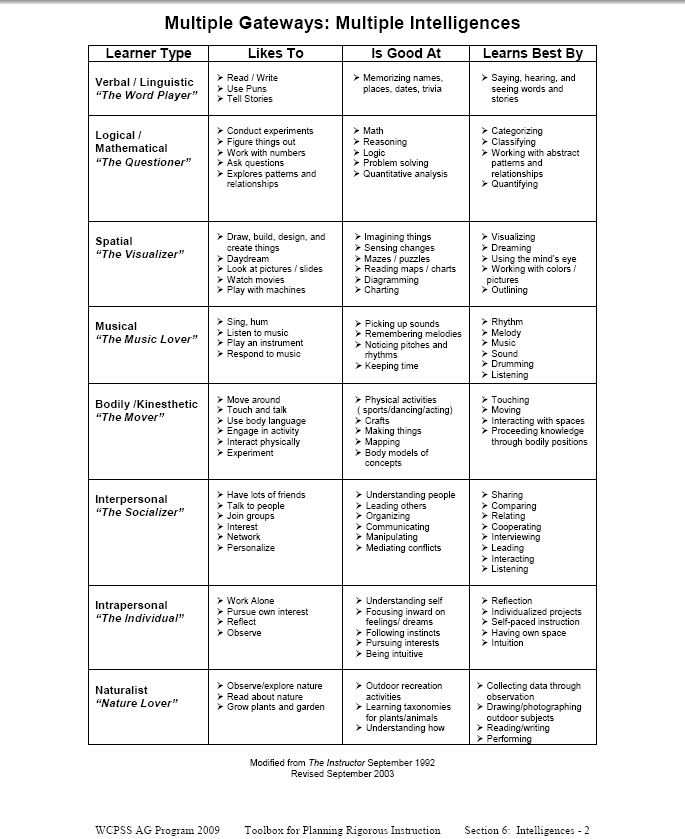
Despite the discrepancies that may exist in a child’s intellectual development, children exercise a variety of intellectual abilities in their everyday lives. An American psychologist by the name of Howard Gardner proposed that individuals have multiple intelligences, which include linguistic, logical-mathematical, spatial, musical, bodily-kinesthetic, interpersonal, intrapersonal, and naturalist intelligence. Each of these intelligences are equally valuable and viable. While every person is smart to varying degrees in each of these different abilities, it is common that individuals are stronger in some ways and less developed in others. As a parent or educator, it is essential to allow children to explore their intelligences and be able to have some choice in how they demonstrate their knowledge. In doing so, we will be better able to serve and meet a child’s individualistic needs. All in all, I find that the following suggestions may better assist those who work or are involved with children on a day to day basis: be open minded about the ways in which children might demonstrate intelligence, emphasize a child’s individual strengths when teaching new topics or skills, give children the support they need to think more intelligently, and encourage independence.
How Does Your Child Learn Best?
References
McDevitt, T. M., & Ormrod, J. E. (2013). Child Development and Education. Upper Saddle River, NJ: Pearson Education.
 Child Development and Education